

Developed a custom e-commerce store to promote Hovis' festive fashion line in time for Christmas.
Unifying a global digital estate without compromising performance
A strategic roadmap to merge 52 regional domains into a single platform while protecting global search authority.
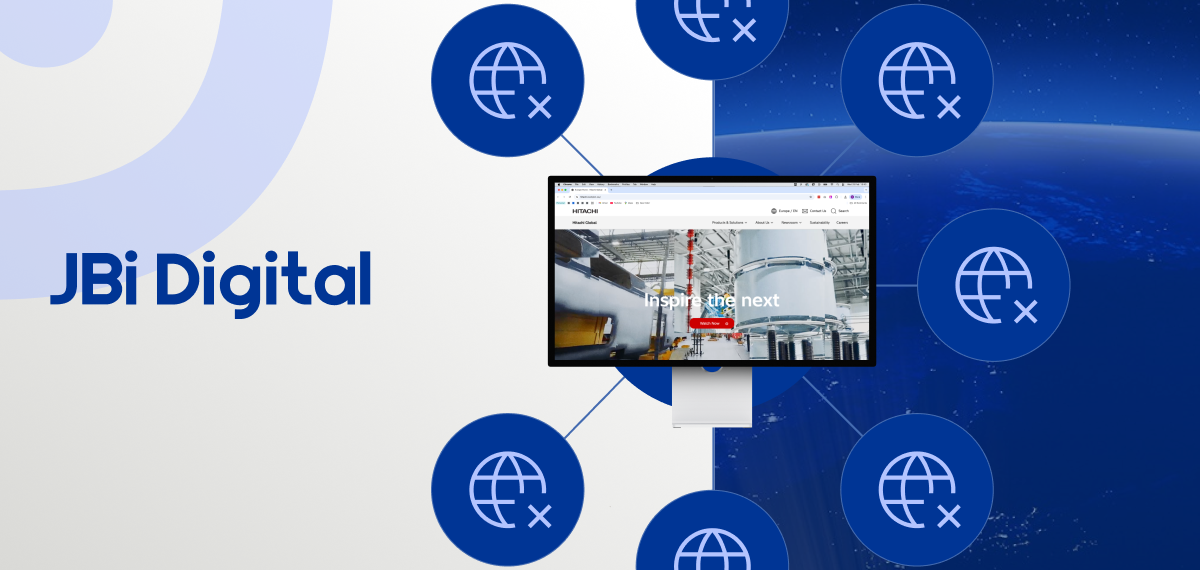
For multinational organisations, digital scale often creates digital fragmentation. Over time regional autonomy can lead to a sprawling estate of disconnected websites, diluted brand identity and escalating maintenance costs.
Hitachi faced exactly this challenge. As a global leader in social innovation, they operated 52 regional corporate websites across 31 languages, which had become a complex web of gateways. While these sites served local markets, they often competed with one another for search traffic, duplicated content and offered inconsistent user journeys.
Hitachi had been a partner of JBi Digital for over six years at this point, building on this established trust, JBi was commissioned to lead the critical discovery phase. The objective was to architect the strategy for merging their fractured international presence into a single Hitachi platform.
The Strategic Context: The Cost of Fragmentation
The decision to consolidate a global estate is rarely taken lightly. For Hitachi, the drivers were clear but the execution was fraught with complexity.
The existing decentralised model was characterised by significant operational variance. The estate was built on different technologies and managed by different digital teams. Each team pursued very localised strategies that were often not in line with the broader corporate strategy.
This fragmentation meant that regional sites were inadvertently competing with the global site for SEO rankings. Furthermore, maintaining 52 separate domains resulted in 52 separate hosting bills, security protocols and maintenance contracts.
The goal was to centralise corporate information while maintaining the flexibility for local marketing teams to speak to their specific audiences. To achieve this, JBi needed to understand not just the technology but the culture, business drivers and complex compliance landscape of every region involved.
The Methodology: A Forensic Discovery Phase
Led by our strategy team and executive sponsor, a data-led discovery process was designed to quantify the scale of the migration challenge.

Stage 1: Global Stakeholder Alignment
Migration projects often fail due to a lack of local buy-in. JBi conducted remote requirement-gathering workshops with the global teams at Hitachi to understand the broader context.
Beyond simply gathering expectations and KPIs, the team dug into the operational reality of the network. This included mapping organisational structures, stakeholders and business drivers. Crucially, the workshops addressed specific risk factors including:
- Compliance: Regional variances in GDPR and data protection regulations.
- Accessibility: Ensuring the new platform would meet global compliance standards.
- Technical Constraints: Identifying requirements for tracking, data capture and language support across the diverse regions.
Stage 2: The Digital Footprint Audit
The technical, UX and SEO teams at JBi undertook a comprehensive audit of all 52 Hitachi websites. This was not a surface-level review, this was a deep dive into the infrastructure, data and content of the entire estate.
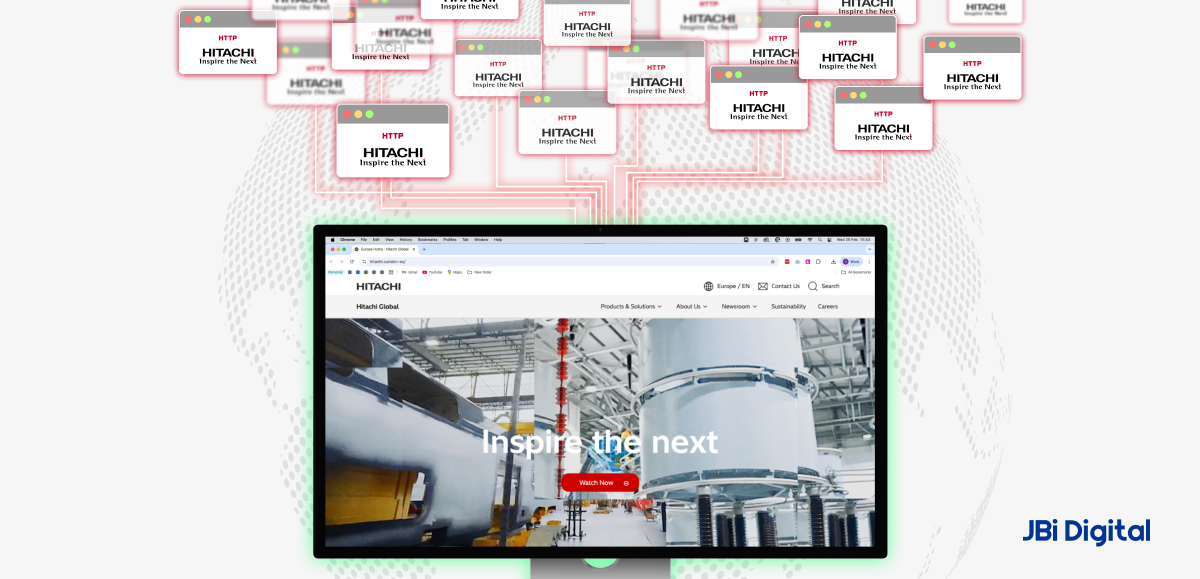
Website & Infrastructure Audit
The team mapped the full digital footprint to understand the technical debt and migration complexity. This included:
- Volume Analysis: Auditing the sheer size of the estate, including page counts and digital assets such as PDFs, images and videos.
- Feature Mapping: Identifying local features that needed to be preserved or rebuilt, such as subdomains, extranets, login areas, e-commerce functionality and data forms.
- Tech Stack: Reviewing the existing hosting infrastructure, Content Distribution Networks (CDN), third-party integrations and CMS selection to inform the future architecture.
SEO & Migration Readiness
A critical part of the audit was assessing the risk to search visibility. The team analysed key rankings for the Hitachi brand name and reviewed the ratio of pages indexed on Google versus those crawled. The audit identified specific technical issues that could derail a migration:
- Technical Errors: HTTP/HTTPS conflicts, canonicalisation issues, internal redirect chains and loops.
- Content Bloat: Identifying duplicate pages, junk pages and programmatically generated clutter such as nodes or tags.
- Visibility: Reviewing visibility on the Google Knowledge Graph and Google Maps, alongside a full backlink analysis.
Analytics & Behaviour Review
JBi conducted a full review of the analytics platforms used on each website to validate the data quality. This involved assessing conversion tracking and identifying top-performing and non-performing pages. By analysing past traffic, audience behaviour and device preferences, the team highlighted specific risks and opportunities for the migration.
Unified Sitemap Creation
Finally, the team created a comprehensive sitemap of all existing sites. The challenge was not just consolidation, but preservation. The team focused on identifying high-ranking localised pages that were driving significant regional traffic and mapping them into a unified global structure.
This process involved determining exactly which local content assets carried SEO equity and fitting them into a new architecture defined by strong central governance. By establishing clear rules on where local content lives within the global hierarchy, JBi ensured that valuable regional pages were preserved without compromising the consistency of the master brand.
Delivery Insight: Balancing Global Control with Local Autonomy
One of the primary risks in centralisation projects is the alienation of local marketing teams. If the new system is too rigid, regions may bypass it, leading to shadow IT and further fragmentation.
To mitigate this, the proposed sitemap framework from JBi was designed on a principle of Empowerment within Guidelines. The roadmap outlined a technical architecture that centralises core corporate content to protect brand consistency while granting regional editors flexibility to manage localised news, blogs and case studies.
To support this, JBi delivered a comprehensive Communication Plan designed to help the central team gather buy-in from regional stakeholders. This framed the migration as an upgrade to their capabilities rather than a removal of their autonomy.

The Value: A Roadmap for the C-Suite
Following the review of over 50 domains, JBi consolidated the findings into a definitive 2-year project roadmap presented to the Hitachi Global team. The value of this discovery phase lay in the clarity it provided for decision-making.
- Strategic Clarity: The roadmap provided a clear breakdown of migration readiness by domain, allowing Hitachi to prioritise the migration based on complexity and risk.
- Cost Efficiency: By outlining a path to a single CMS and hosting infrastructure, the roadmap highlighted significant long-term savings in maintenance and technical debt reduction.
- Performance Certainty: The deep-dive SEO audit ensures that when the migration begins in Phase 2, there is a watertight plan to preserve and enhance search rankings for Hitachi.
Testimonial
“JBi has been instrumental in helping us with our online activities and strategy. The team has been an absolute pleasure to work with. They are always proactive in their support and we are very much looking forward to seeing what our relationship brings in the future.”
Simon Crouch, Brand Manager at Hitachi Europe
At a glance
- The Objective: To audit 52 regional websites and architect a roadmap for consolidating them into a single One Hitachi global platform.
- The Approach: A remote global discovery phase involving stakeholder workshops, technical infrastructure auditing and granular content analysis.
- The Outcome: A migration strategy designed to deliver a stable, unified platform without compromising existing global performance or SEO rankings.
More Projects

3D Printing


Building a future-proof website to support the digital reputation of one of the UK’s leading independent media production and broadcast journalism companies.

