
Why Drupal Remains the Gold Standard for Enterprise Multi-Regional Digital Ecosystems.
For global enterprises managing multilingual, multi-regional digital properties, the choice of a Content Management System isn't merely a technical decision, it's a strategic imperative that impacts security posture, operational efficiency, and ultimately, brand reputation across markets.
As organisations expand their digital footprint across jurisdictions with varying data protection regulations, the vulnerabilities inherent in many popular CMS platforms become untenable. A single security breach or prolonged downtime in one region can cascade across an entire global operation, eroding customer trust and triggering regulatory penalties.
This is where Drupal distinguishes itself, not through marketing promises, but through a proven track record of powering government agencies, healthcare and enterprises. The platform is widely deployed in regulated industries where security, compliance, and audit trails are mandatory requirements.
Multilingual and Multi-Regional Excellence.
Built for global operations.
Managing content across languages and regions isn’t about translation, it is about localisation workflows, content governance, and maintaining brand consistency whilst respecting cultural nuances.
Unlike competing platforms that require a third-party plugin, Drupal’s multi-lingual and multi-regional support is built directly into its core. No additional licensing and no fragile dependencies.
Where other platforms struggle:
URL pattern management
Most CMS platforms force compromise when structuring URLs across regions.
- Domain per region (www.yourbrand.uk, www.yourbrand.fr) which dilutes SEO and increases cost.
- Subdirectory structures (/uk/, /fr/) offer limited control with messy routing
- Subdomain approaches (uk.yourbrand.com) which complicates SSL certification and tracking.
Drupal handles all three natively, with granular control over URL patterns, language negotiation and regional routing - no custom development required.
Core functionality vs plugin dependency
WordPress requires WPML or Polylang for multilingual support. These plugins add per-site costs, are vulnerable to breaking during updates and create vendor lock-in. Enterprise sites like Sitecore and Adobe Experience Manager offer multilingual support only at premium licensing tiers that exclude mid-market organisations.
Drupal's multilingual system is core functionality:
- Content translation workflows: Review, approval, and publishing pipelines per language with role-based permissions.
- Interface translation: Admin experience available in 100+ languages as standard.
- Regional content variations: Different content for different markets, not just translations, handling cultural nuances, regulatory differences, and market-specific messaging
- SEO optimised language negotiation: Proper hreflang implementation and URL structures without custom development
Distributed teams, centralised governance
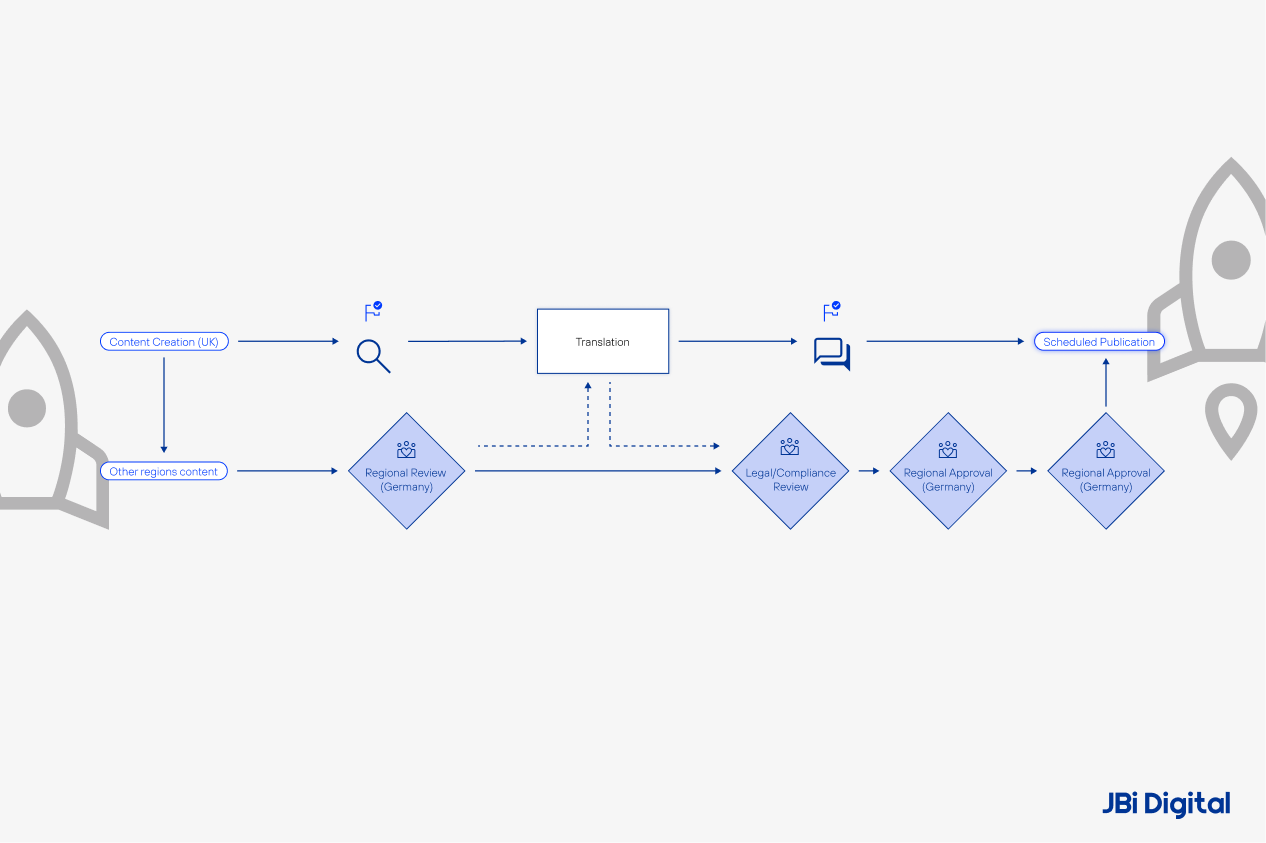
- Workspaces: Regional teams can develop content in parallel without conflicts.
- Content moderation: Multi stage approval workflows balance regional autonomy with global oversight.
- Domain access: Manage multiple domains from a single installation with separate analytics, user bases and content libraries.
- Granular permissions: Regional admins control their content, translations and publishing schedules without accessing other regions' materials.
Security Architecture Built for Zero-Trust Environments.
Enterprise-grade security by design
Drupal's security model operates on principles familiar to enterprise security teams: defence in depth, least privilege access, and continuous validation. Unlike platforms that bolt on security features as afterthoughts, this secure CMS platform has security woven into its architectural foundation.
The Drupal Security Team operates as an independent entity that proactively identifies vulnerabilities, coordinates with contributed module maintainers, and releases security updates on a predictable Wednesday schedule. This isn't just incident response, it's systematic threat management.
For enterprises, this translates to:
- Predictable security maintenance windows: Security teams can schedule updates knowing exactly when patches will be released.
- Transparent vulnerability disclosure: CVE tracking and severity ratings allow proper risk assessment.
- Backwards compatibility: Security updates rarely break existing functionality, minimising regression testing overhead.
Compliance-ready out of the box
Organisations operating under GDPR, CCPA, HIPAA, or FedRAMP requirements face complex data governance challenges. Drupal provides granular content access controls, audit logging, and data handling features that support compliance frameworks:
- User consent management and cookie controls
- Data anonymisation and right-to-be-forgotten workflows
- Field-level encryption capabilities
- Role-based access control (RBAC) with inheritance
Real-world validation: When organisations like NATO, the Australian Government, and major pharmaceutical companies choose Drupal, they're not making casual technology selections. These are organisations where security failures have geopolitical or life-safety implications.
Technology Agnostic Integration: The Headless Advantage
Decoupled architecture for modern development teams
Enterprise digital ecosystems rarely consist of a single website. They encompass mobile applications, IoT interfaces, digital signage, voice assistants, and emerging channels that don't exist yet. This is where Drupal's API-first architecture becomes invaluable.
Drupal as a headless CMS means content exists independently of presentation:
- JSON:API and GraphQL endpoints provide standardised content delivery
- Framework agnostic: Front-end teams can use React, Vue, Angular, or Next.js without CMS constraints
- Omnichannel content distribution: Publish once, deliver everywhere, from web properties to mobile apps to smartwatch interfaces
Asa FiskJBi Digital"We've seen enterprises struggle with CMS platforms that promise flexibility but deliver vendor lock-in. Drupal's architecture allows us to build systems where security isn't a feature, it's the foundation. When you're handling sensitive data across multiple jurisdictions, the technology needs to be as discrete as your development partner. That's not negotiable."
Integration without technical debt
Enterprises operate on heterogeneous technology stacks. Marketing might use Salesforce, operations use SAP, customer service uses ServiceNow. Drupal's open architecture and extensive integration capabilities mean:
- RESTful APIs for bidirectional data exchange.
- Webhooks for event-driven integrations.
- Pre-built connectors for major enterprise platforms (Salesforce, Marketo, Azure, AWS).
- No vendor lock-in: Your integration investments aren't hostage to platform licensing changes.
Enterprise Performance and Reliability
Built to handle traffic at scale
Global enterprises can't afford downtime during product launches, viral campaigns, or crisis communications. Drupal's performance characteristics support high traffic scenarios:
- Advanced caching: Page caching, database query caching, block caching with BigPipe for progressive enhancement
- CDN integration: Native support for Fastly, Cloudflare, Akamai, AWS CloudFront
- Horizontal scaling: Stateless architecture supports load-balanced, containerised deployments
- Database optimisation: Query optimisation and support for replicated database architectures
The Partnership Advantage
Working with Drupal specialists
Choosing Drupal means access to an ecosystem of agencies and development partners who understand enterprise requirements. At JBi Digital, we recognise that enterprise clients require:
- Discretion and confidentiality: NDA-protected development, secure development environments, and understanding of prelaunch sensitivity.
- Proven methodologies: Agile development adapted for enterprise governance, with clear documentation and knowledge transfer.
- Security-first approach: Secure development practices, penetration testing, and security audits as standard practice.
- Long-term partnership: Not project-based relationships, but strategic partnerships that evolve with your digital maturity.
Strategic Technology Selection
For enterprises managing multi-regional, multilingual digital properties where security, performance, and flexibility are non-negotiable, Drupal represents more than a CMS, it's a strategic platform for digital innovation.
The question isn't whether Drupal can handle enterprise complexity. Organisations from Tesla to the United Nations have already answered that. The question is whether your current CMS can continue to meet your evolving security, integration, and scaling requirements, or whether you're accumulating technical debt that will constrain your digital ambitions.
Ready to explore how Drupal can transform your enterprise digital ecosystem?
Contact JBi Digital to discuss your multi-regional, security focused web development requirements with specialists who understand the stakes.
FAQ
Yes. Drupal's dedicated security team, predictable patch schedule, and architectural security model make it significantly more suitable for enterprise deployments than WordPress.
Drupal's built-in multi-lingual capabilities include content translation workflows, interface translation in 100+ languages, and regional content variations.
Yes. Drupal provides robust integration capabilities through RESTful APIs, webhooks, and extensible plugin architecture. Pre-built contributed modules are available for major enterprise platforms including Salesforce, Marketo, SAP, and ServiceNow, reducing integration effort and accelerating time to deployment.