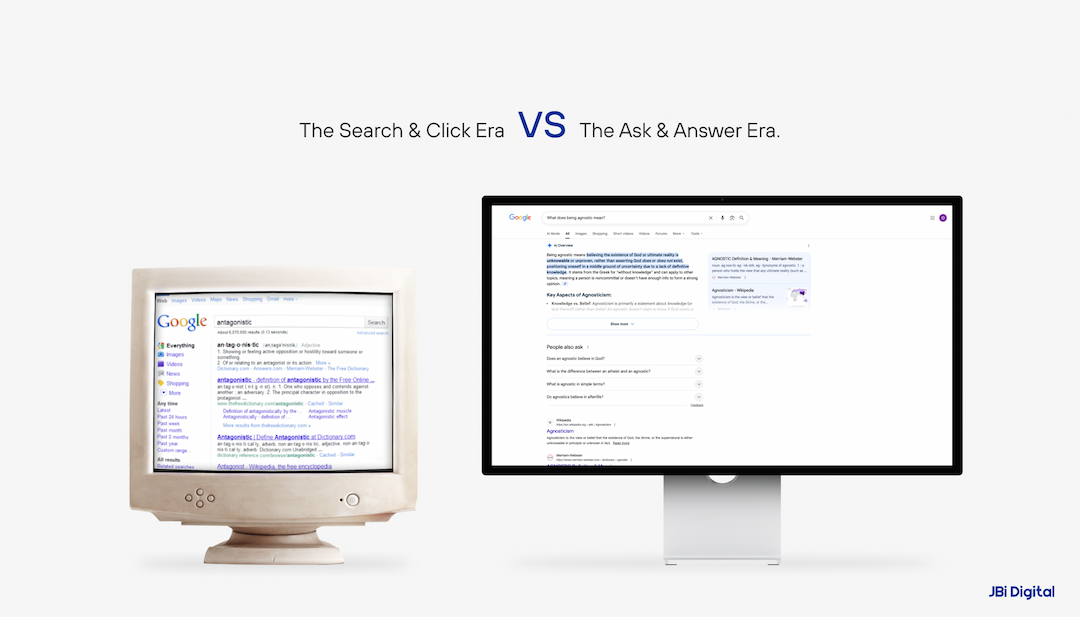


Navigating Digital Transformation: A Glossary For Marketers
Strategic Definitions for the Modern Marketer
At JBi, we believe that technology should never be a barrier to conversation. As the digital world moves toward more automated and integrated models, the terminology can feel overwhelming. This unified glossary translates complex technical concepts into what they actually mean for your business: better customer experiences, reduced risk, and measurable growth.
1. Artificial Intelligence & Emerging Search
- AEO (Answer Engine Optimisation): The strategic successor to traditional SEO. Instead of focusing solely on ranking for hyperlinks, AEO ensures your data is structured so that AI interfaces (such as Perplexity or Gemini) can “answer” queries about your brand directly and accurately.
- Agentic AI / Agentic Workflows: Systems designed to do more than just generate text; they possess the autonomy to carry out multi-step tasks. An agentic workflow can execute actions, such as managing a complex customer refund across several databases, with human oversight at defined risk or approval points, without needing human intervention at every stage.
- Agentic Commerce: An emerging evolution of e-commerce where AI agents autonomously manage the shopping journey, from inventory checks to personalised negotiations, acting on behalf of the brand and the consumer.
- Knowledge Graph: A programmatic map of your brand’s information. It defines the relationships between products, prices, and services, allowing your organisation to operate as a governed source of truth for answer engines.
- Citizen AI Development: A model where non-technical staff (the “citizens”) are empowered to build their own simple AI tools or “mini-agents” using low-code platforms, reducing the burden on the central IT department while maintaining central governance and security controls.
2. Data Architecture & Infrastructure
- The Use of “Estates”: In a digital context, an “estate” refers to the entire collection of a brand’s online assets, including all websites, applications, hosting environments, and databases.
- Digital Estate Consolidation: The strategic process of unifying disparate digital assets into a single, high-performance ecosystem to reduce technical debt and cost.
- Sovereign Data: Data that is stored and processed within a specific national jurisdiction (e.g., the UK). This is essential for managing legal risk under frameworks such as GDPR and the Data (Use and Access) Act 2025.
- Data Mesh: A modern approach where data is managed by the teams that actually use it (like Marketing), rather than being siloed in IT. It treats your data as a high-quality, curated product supported by shared standards, governance, and platform services. .
- Data Engineering: The foundational work of building systems that collect and convert raw data into usable information for marketing analysts and AI models.
- Cloud-Native Development: Building applications specifically for the cloud, resulting in software that is more scalable, flexible, and resilient than traditional on-premise apps.
- Cloud Resilience: The ability of a cloud system to remain operational and recover quickly from failures or traffic surges. It is the “safety net” for mission-critical services.
- Legacy Wrapping: A pragmatic modernisation strategy. Rather than a high-risk “rip and replace” of aging databases, we build a modern API layer (the “wrapper”) on top to allow for immediate AI integration.
3. Security, Assurance & Compliance
- Secure-by-Design: An approach where security is integrated into the foundation of a digital product from the outset, rather than being “bolted on” at the end.
- Zero Trust Patterns: A security model based on the principle of “never trust, always verify,” requiring every user and device to be authenticated before gaining access to data.
- CHECK-aligned Penetration Testing: Testing conducted by teams following the NCSC CHECK scheme, ensuring your systems meet the highest UK government standards for identifying vulnerabilities.
- NCSC CHECK: A UK government-run assurance scheme, operated by the National Cyber Security Centre, that accredits companies to provide penetration testing services to the public sector and critical organisations.
- Quantum-Safe Security: Cryptographic methods designed to protect data against the massive computing power of future quantum computers.
- Digital Identity Management: Technologies used to ensure the right individuals have access to the right resources, protecting against fraud and “deepfake” identity theft.
- GDS Standards (Government Digital Service): A rigorous set of design and technical standards used to ensure public facing digital services are accessible, secure, and user-centric.
- Cyber Essentials Plus: A verified UK certification confirming an agency has technical controls in place to protect against common cyber threats.
- G-Cloud 15: The UK’s official digital marketplace for the public sector procurement, where suppliers are pre-vetted for compliance, commercial standards, and public-sector readiness.
4. Operations & Strategy
- “Hard-Hat” Technical Engineering: Robust engineering for critical infrastructure where stability and reliability are the absolute priority.
- Sustainable Tech Audits: A review of a digital estate’s environmental impact, focusing on reducing carbon emissions and improving energy efficiency.
- Tech Talent Strategy: A long-term plan to attract and retain the technical staff required to run a digital-first business.
- Digital Transformation Index: A benchmarking tool used to measure an organisation’s digital maturity compared to its competitors.
- Omni-channel Experience Design: Creating a seamless and consistent customer journey across every touchpoint, from mobile apps to physical stores.
- Workday Implementation: The process of integrating Workday’s enterprise software into an organisation’s existing technical ecosystem.
- Upskilling / Capability Building: A co-delivery model where we train your internal team to manage new technology, ensuring you own your digital future.
Red Flags to Watch For:
- “Black Box” AI: If they cannot explain how the AI makes decisions, it is a liability for your brand authority.
- Vendor Lock-in: If there is no Upskilling or Capability Building in the contract, you may be paying them for simple updates indefinitely.
- Security as an Afterthought: If Secure-by-Design isn’t mentioned until the end of the project, your data is at risk.
A Helpful Note on Best Practice
Our Perspective: Digital transformation reaches its peak efficiency when your internal team feels empowered to make autonomous, high-velocity decisions. At JBi, our role is to make these complex concepts invisible to your customers by building systems that simply work, securely, sustainably, and at scale.
Similar Reads
Our latest news articles featuring company insights and what we have achieved so far