Meet the bot that replaced our contact form
One year ago this month we launched a brand new website for the agency. Alongside our refreshed brand, we introduced
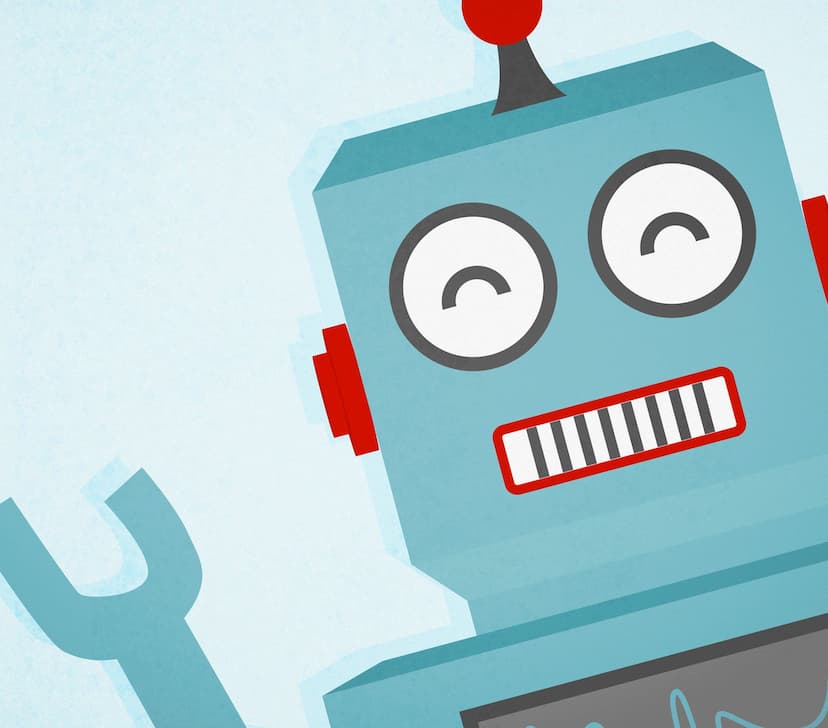
Jake – a chatbot, built to assist website visitors with their enquiries.
Jake was built from the ground up to handle the task of passing details from visitors to our website who wish to make
enquiries for our team to action . Over the past year, he has been working hard to prove himself capable of
replacing the traditional contact form.
Our website has always included a contact form for sales and general enquiries, but we discovered a glaring issue
with it – visitors didn’t give us all the details required to effectively assist them when filling out the
contact form. This resulted in emails back to the enquirer asking for additional information so we could move
forward – not a great way to kick off a business relationship.

After all, great relationships don’t start with
forms and emails – we want to chat as soon as possible
It was apparent that we’d have to provide fields for all the details we needed to fully understand
the visitor’s enquiry, but that would result in a long, arduous form.
So how could we gather the visitor’s details while providing them a pleasant experience?
We looked at a number of solutions to address this issue, but it was ultimately narrowed down to just
two – a form with procedurally generated fields or a chatbot.
A form with procedurally generated fields would add additional fields based on the information the
user provided. For example, if a field asked for the purpose of the visitor’s enquiry, an
additional field asking for their company name will appear if they entered ‘a new project’ in
the purpose field. But this didn’t really solve the problem, it just made the form look
less intimidating to begin with.
A chatbot, on the other hand, could also ask for additional details depending on the information
provided, whilst requesting those details in an organic way. For example, where a field would
be accompanied by a label reading ‘Company Name’, a bot could say ‘Tell me a bit about your
company, such as its name…’
Another advantage to the chatbot was how it would handle input validation. Typically, a field in a
form would be highlighted in red with a message when the information entered is invalid. The
message would usually provide some guidance on what the field requires, but the guidance that
you can provide in an error message is limited. The chatbot, however, could provide a different
approach to extract the correct information. For example, if a visitor doesn’t have a brief for
their project the bot could ask alternate questions to fill in the blanks that would have been
covered by a brief.
We had two concerns with using a chatbot in place of a traditional contact form:
- Would leads take the chat interface seriously?
- Would visitors confuse it with a live messaging service like Intercom?
To overcome the first concern, we knew we’d have to be clear about Jake’s purpose so alongside a
descriptive introduction we settled on providing suggestions for questions Jake posed. In an
effort to keep Jake professional and approachable, the messages are clear and descriptive but
also casual and friendly.
The second concern was a little more challenging. Chatbots are still an emerging trend and the most
exposure people have had with website chats are live chats – a chat between two people, no bots
involved. While there’s nothing wrong with live chats, visitors may not wish to talk to someone
directly at this stage, hence their decision to use the contact form instead of phoning. To
overcome this, we realised we’d have to give Jake a face and a personality so visitors wouldn’t
think of him as an actual living breathing person in our office.
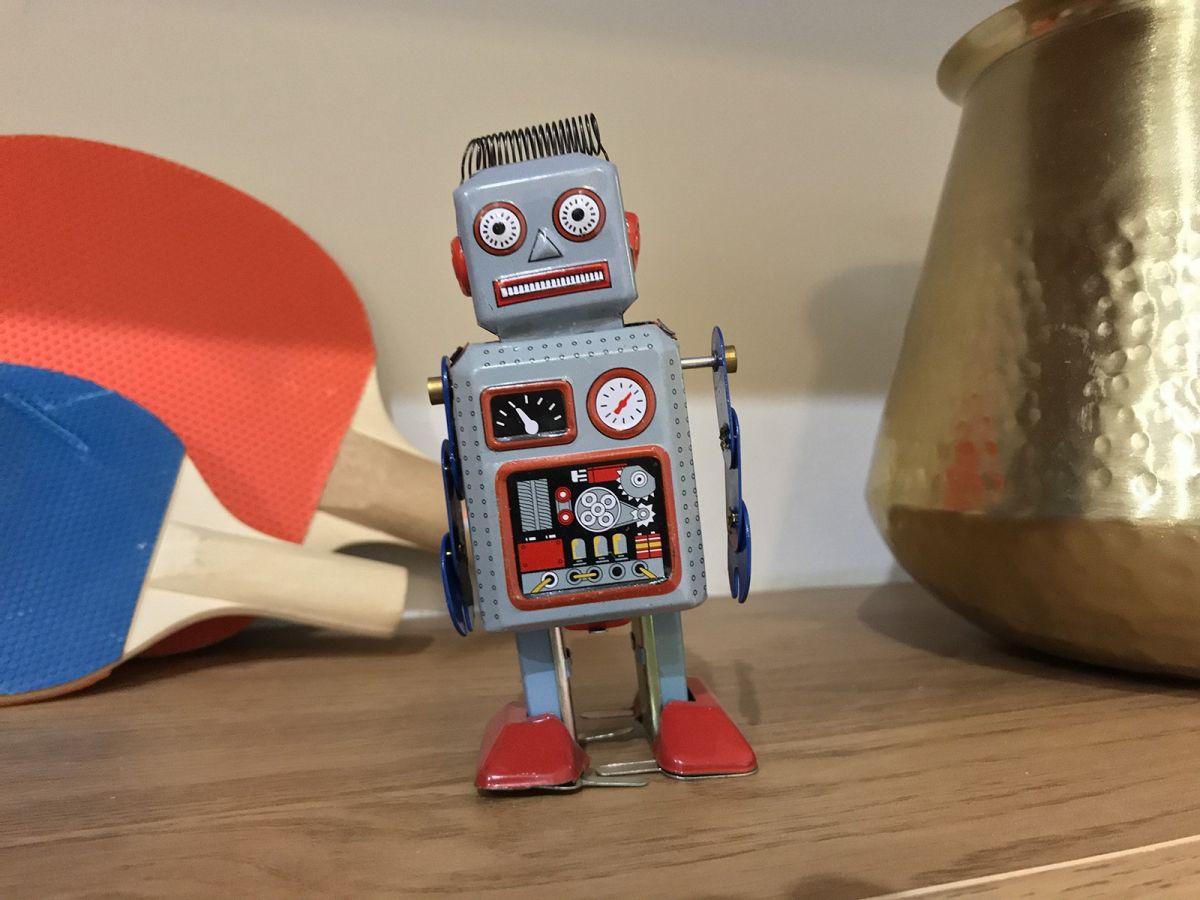
Our creative team discovered a small tin robot toy in a shop and knew they had found Jake. The toy
now sits on a shelf in our reception area – appropriately greeting people as they arrive.
Now that Jake had a face, he needed a personality.
Our team has a penchant for digital easter eggs – hidden jokes and references that can only be
uncovered by the most dedicated user. So it wouldn’t be a JBi project if Jake didn’t have a few
hidden tricks of his own, he has 96 in fact. Jake is actually a bit of a comedian – just ask him
to tell you a joke. Jake’s also picked up a few skills from voice assistants; he can tell you
the weather, change accessibility settings on the website and more, but we’ll let you discover
those for yourself.
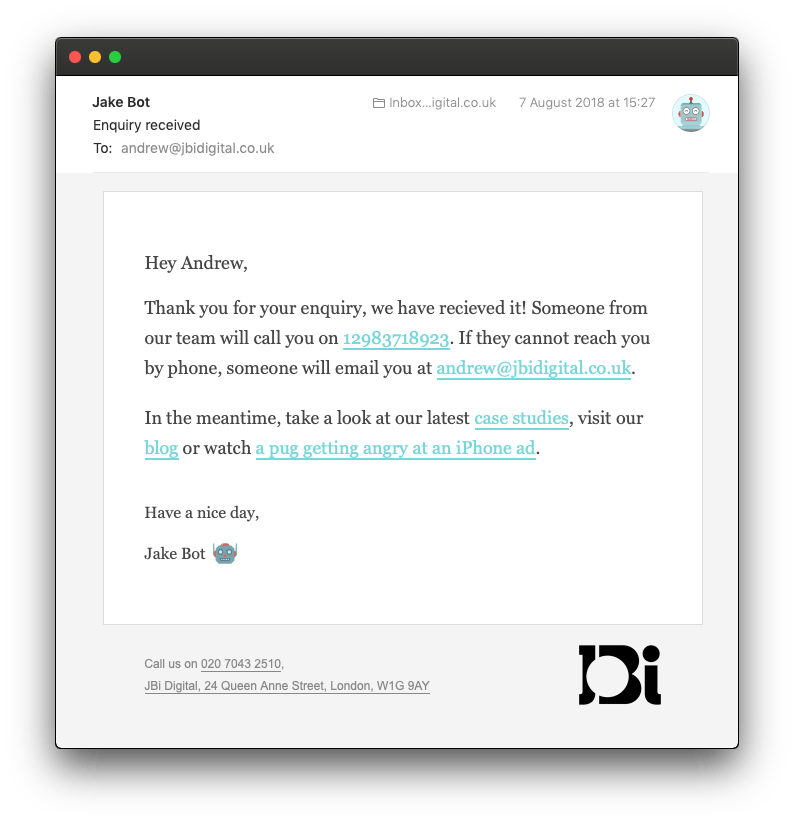
Once Jake has collected the details the team requires to kick off a conversation with the enquirer,
he asks for permission to share them with the JBi team in accordance with GDPR regulations and
promptly sends the visitor an email to confirm its delivery.
Could a chatbot help your business?
Chat is the interface of the future – this is evident by the momentous rise of voice assistants like
Siri, Google Now and Alexa. Recently, Facebook and Skype introduced bots to their chat services,
assisting businesses with customer enquiries. But so far, chat interfaces haven’t made a
noteworthy appearance within websites.
Jake has proven that we can get all the details we need from an enquirer while providing them with a
fun experience. Jake brings a lot of personality to our brand and has quickly become a mascot
within the company and his responsibilities are growing every month – he now sends reminders to
members of the JBi team if they don’t log their hours.
Additionally, Jake inspired the creation of the chatbot
on Geekmate – a service that assists people in creating
formal dispute letters, a perfect application for a chatbot.
A chatbot opens up a range of opportunities to interact with your users in new ways. The bot can
respond to a situation far better than traditional forms and collect more valuable details in
the process.
Chatbots work great with APIs and can be deeply integrated into existing systems. Integrating a
chatbot into your website’s search, for instance, would allow the bot to surface relevant
content in the context of a conversation and help people discover content using natural
language.
Users have a more pleasant experience when an interface responds and evolves to their actions leading
to lower bounce rates and higher conversion rates – we noticed that people now spend the
majority of their time on our contact form when visiting our website.



Digital transformation. Delivered securely.
Let’s discuss your objectives.