
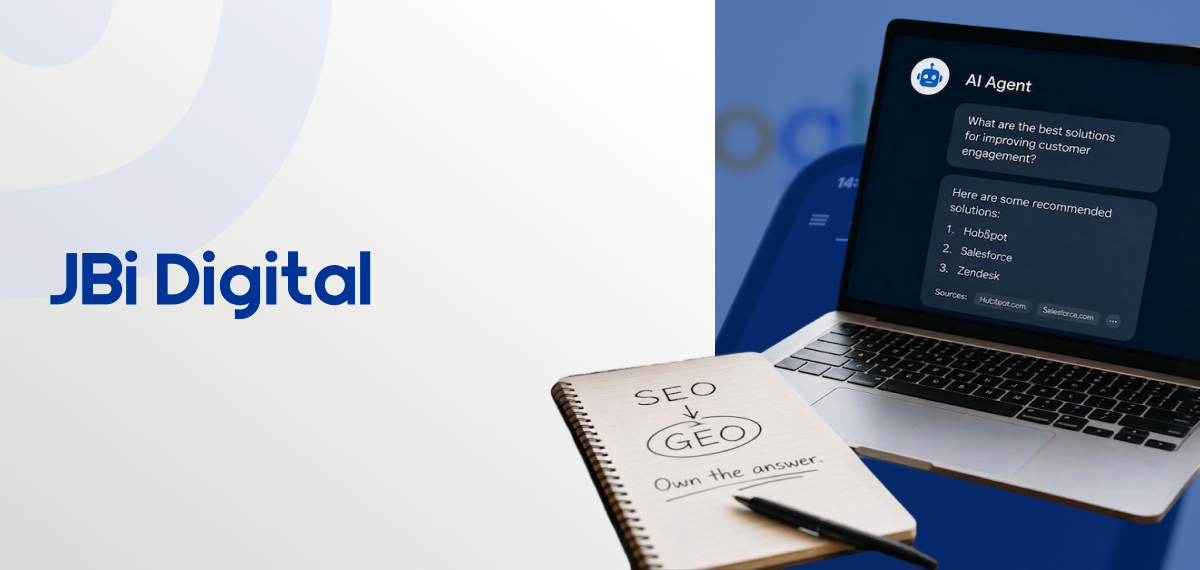
The new search reality: SEO vs GEO
For decades, the goal of Search Engine Optimisation (SEO) was simple: rank high on Google to drive traffic to your website. In 2026, while traditional ranking remains important, it is no longer the only major goal.
We are seeing a seismic shift towards Generative Engine Optimisation (GEO). The main difference is that while old SEO focused on winning the click, GEO is about owning the answer. AI agents now provide comprehensive summaries that often mean a user never needs to visit your page to get the information they need.
![Visual: A diagram showing the ‘Traditional Search’ path (User -> Google -> Website) vs the ‘2026 Agentic’ path (User -> AI Summary providing the answer immediately with a ‘Cited by [Brand]’ badge)](https://www.jbidigital.co.uk/wp-content/uploads/2026/05/Featured-Article_-The-click-is-dying.-Are-you-ready_-2-1200x570.jpg)
Four pillars of the 2026 strategy
- Winning the citation: AEO and GEO
We now optimise for Answer Engine Optimisation (AEO). This ensures that when a user asks a complex industry question, the AI provides an answer that credits your brand as the authority.
- The Strategy: We create authoritative pillar content focusing on unique data points specifically formatted for AI models to reference.
- The Outcome: Your brand becomes the ‘gold standard’ source for AI engines, maintaining visibility even when users do not click through to a website.
- The liquid interface: Removing friction
A static website is a barrier to conversion. We use interfaces that change in real-time based on who is visiting. A CFO should see ROI figures immediately, while a technical lead should see specifications.
- The Strategy: We build modular content blocks that swap dynamically based on the visitor’s job title or industry.
- The Outcome: A seamless, personalised journey that adapts in under 200ms, ensuring you never lose a lead to a slow-loading interface.
- Data integrity: The clean room standard
Dirty data leads to AI hallucinations, where your own AI tools might give customers incorrect or outdated information.
- The Strategy: We ensure your ads and your website are perfectly aligned. For example, LinkedIn intent signals can trigger a bespoke website experience for your high-value accounts.
- The Outcome: A single source of truth that ensures your AI marketing budget is spent on high-quality, actionable inputs.
- Verified human authority
As AI-generated spam saturates the market, buyers are actively looking for human expertise. Trust is the new currency.
- The Strategy: We protect your brand authority. Every piece of original research and video is digitally watermarked to prove it was created by your experts.
The Outcome: Your intellectual property is secured against spoofing, ensuring your customers know they are engaging with verified brand expertise.
The 2026 Director’s Dashboard
This reporting framework moves beyond clicks and impressions to measure the health and agility of your digital estate.
| Strategic Goal | Key Metric | Why it Matters | 2026 Target |
| Market Authority | AI Citation Rate (AICR) | Measures how often AI engines recommend your brand over competitors. | >15% Share |
| Customer Agility | Response Speed (TTFP) | The speed at which your site adapts to a visitor’s intent. | <200ms |
| Operational Risk | Asset Trust Score | The percentage of your content verified as ‘Human-Expert’ to protect against AI spoofing. | 100% (Core IP) |
| Investment Efficiency | Data Readiness | Measures how much of your data is usable by AI tools without manual cleaning. | >80% Ready |
The Collaborative Audit: Five conversations to have today
To ensure your digital estate is 2026-ready, we recommend opening a dialogue with your technical partners and internal teams using these focus points:
- On AI Visibility: Do we currently have a way to track how often AI summaries are citing our brand compared to our competitors?
- On Technical Metadata: Are we utilising Schema 3.0 to ensure our data is easily digestible for AI reasoning engines?
- On Content Trust: What steps are we taking to verify our original assets, perhaps through protocols like C2PA?
- On Site Performance: Does our current hosting architecture allow us to deliver personalised content in under 200ms?
- On Data Health: What percentage of our CRM and CMS data is currently considered AI-ready?
A Final Note
In 2026, expertise is the only thing AI cannot replicate. Use AI for the plumbing: distribution, formatting and translation, but rely on your human experts for the blueprint.
How often is your brand being cited today? If you do not know the answer, it might be time for a digital estate audit.
References and Sources
- Gartner (2025/26): Global IT Spending Forecast. Analysis of ‘Run vs. Grow’ budget allocations.
- MuleSoft (2026): Connectivity Benchmark Report. Research on the ‘Agentic Enterprise’ and AI integration.
- UK Government: Data (Use and Access) Act 2025. Official legislation regarding digital identity frameworks.
- European Commission: European Accessibility Act (Directive 2019/882). Enforcement guidelines for digital services effective from June 2025.
The 2026 Executive Glossary
- C2PA (Content Provenance and Authenticity): A global technical standard that allows brands to “watermark” their content. It proves a video or article was created by your experts and hasn’t been altered by AI.
- Edge Computing: A method of processing website data closer to where the user is located. This is the “plumbing” that allows a site to personalise itself in milliseconds without a loading delay.
- Liquid UI: A website interface that “melts” and reshapes itself in real-time. It uses visitor data to change the layout, messaging, and call-to-action based on that specific person’s intent.
- Schema 3.0: A specific type of code hidden in your website that acts as a “menu” for AI agents. It tells them exactly what your data means so they can cite it accurately.
- TTFP (Time to First Personalisation): A performance metric measuring how quickly a site adapts to a visitor. In 2026, any speed over 200ms is considered a barrier to conversion.