
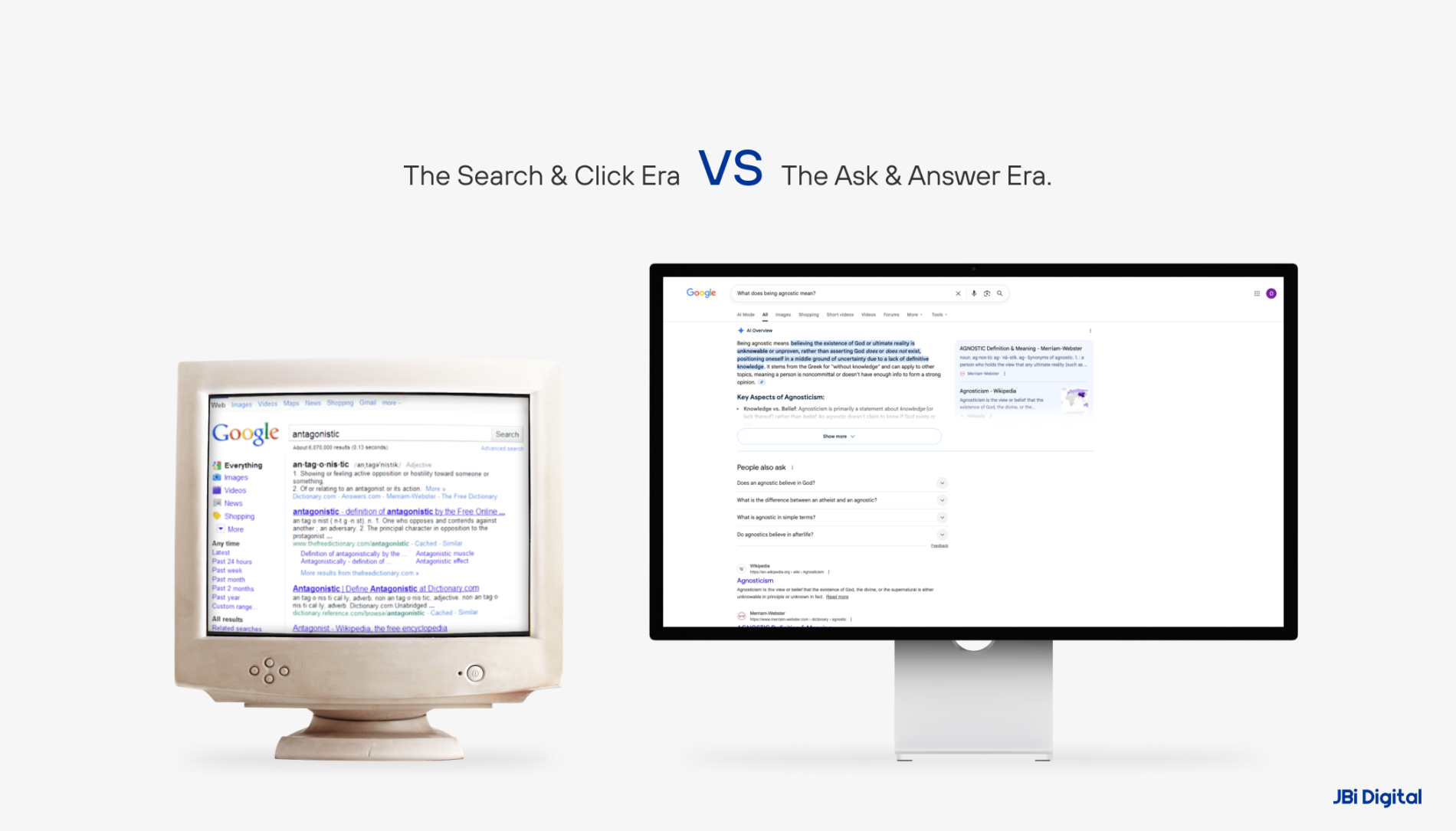
The New Search Paradigm: From Links to Answers
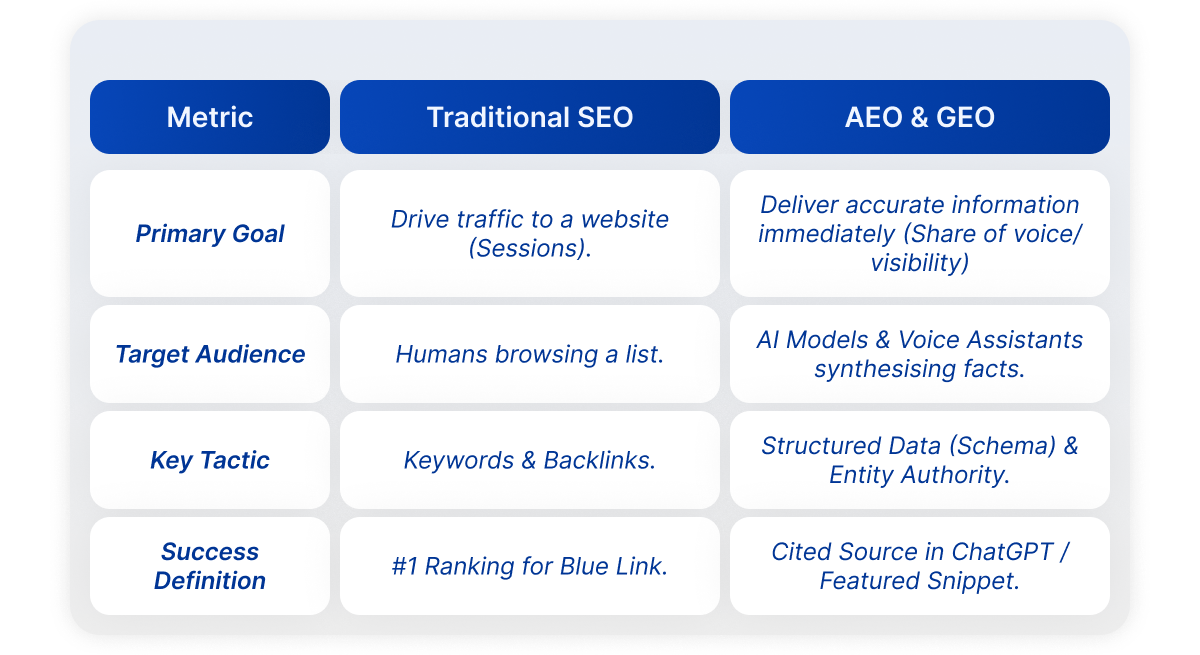
Traditional Search Engine Optimisation (SEO) was about winning the click. You optimised for keywords to drive traffic to your site. AEO and GEO operate differently, they are tailored to engines built for information retrieval and synthesis.
- AEO (Answer Engine Optimisation) is the practice of structuring content to be the direct, spoken, or featured answer to a user’s question. It targets the “Answer Box” on Google or the voice response from Siri or Alexa.
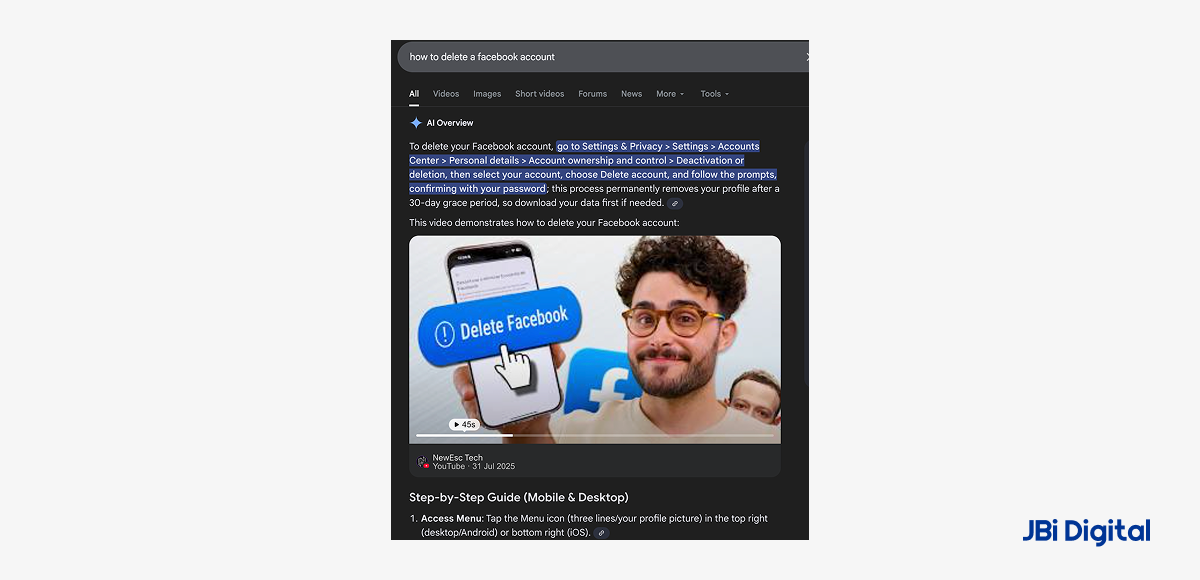
- GEO (Generative Engine Optimisation) is the strategy of optimising content for Generative AI engines like ChatGPT, Claude, and Google’s AI Overviews. These engines don’t just list links: they read, synthesise, and generate a new answer, citing trusted sources.
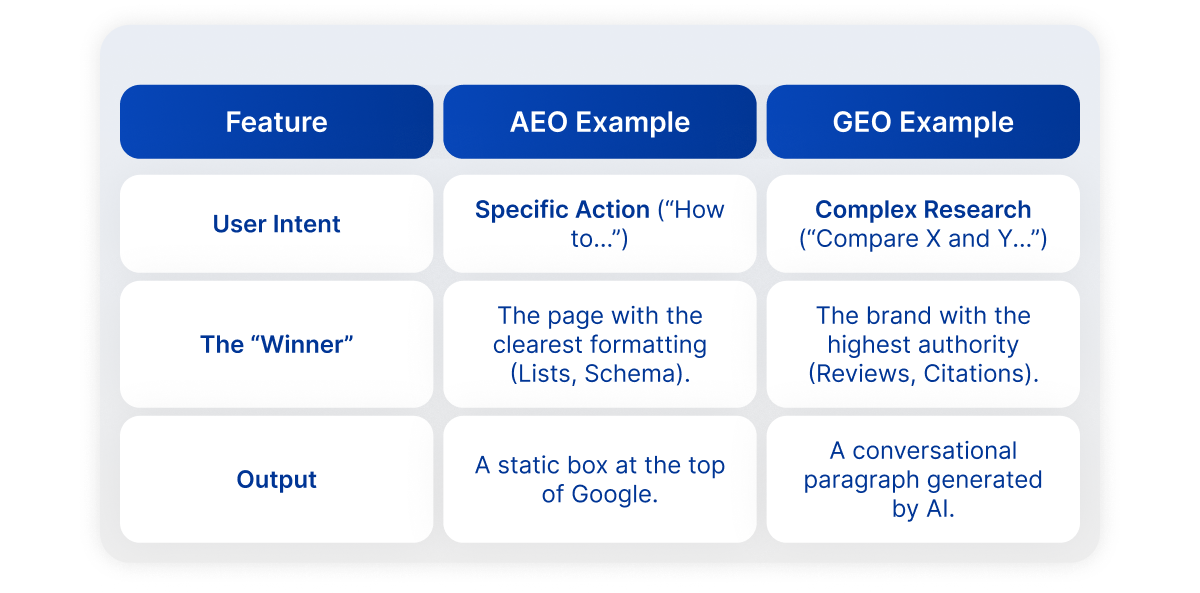
- AEO (Answer Engine Optimisation) is the practice of structuring content to be the direct, spoken, or featured answer to a user’s question. It targets the “Answer Box” on Google or the voice response from Siri or Alexa.
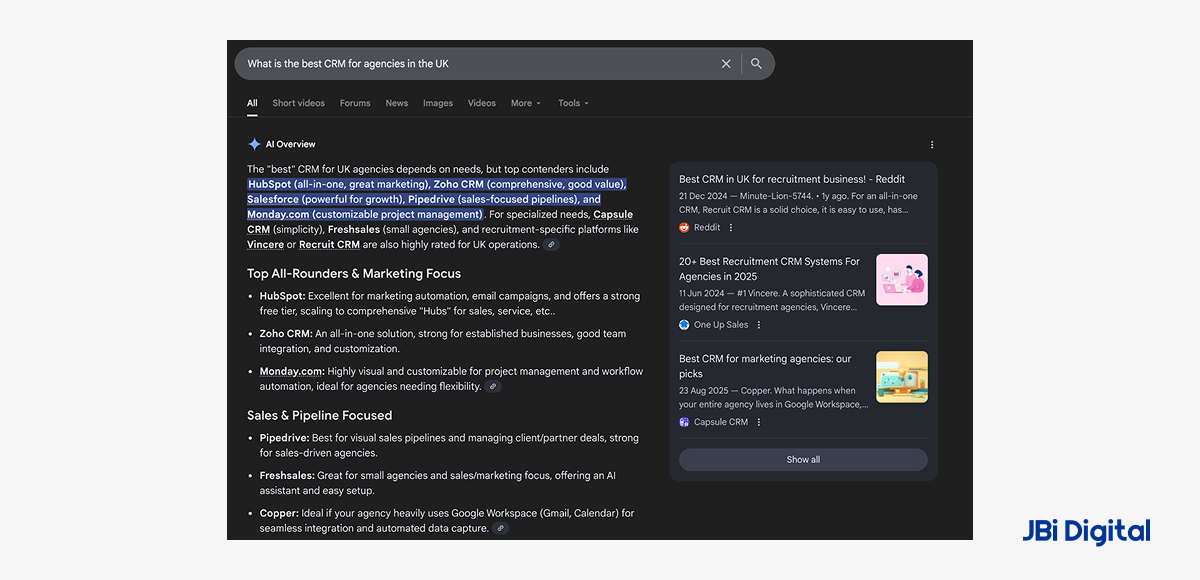
- GEO (Generative Engine Optimisation) is the strategy of optimising content for Generative AI engines like ChatGPT, Claude, and Google’s AI Overviews. These engines don’t just list links: they read, synthesise, and generate a new answer, citing trusted sources.
The Technical Reality: A View from the Frontline
While the strategy is high-level, the implementation is deeply technical. It requires moving away from “writing for keywords” to “structuring for machines.”
We asked Saba Karimi, JBi’s Technical SEO Specialist, to explain the difference:
“At its core, the act of searching hasn’t changed: a user expresses a need, systems generate results, and the user chooses the most relevant answer. What has changed with AI-driven search is how users express that need. Instead of typing short, keyword-dense queries, people now communicate with search engines the same way they speak to other humans, through natural prompts, detailed context, and conversational intent.
This shift requires us to rethink SEO from the ground up. It’s no longer only about optimising for algorithms; it’s about enabling AI systems to fully understand, interpret, and trust your content. That means structuring information clearly, using the right schema to signal meaning, and ensuring internal anchors and topical pathways reflect how real users phrase prompts and ask follow-up questions.
In the AI world, brands that win will be those that write for humans and architect for machines, bridging natural language with technical clarity so AI models can confidently surface their expertise.”
Your Strategic Roadmap: Securing Your Brand in the AI Era
Transitioning to an AEO and GEO-ready framework isn’t just an IT ticket; it is a strategic pivot in how your brand communicates with the world.
To future-proof your market presence, JBi recommends a three-phase plan designed to capture attention before the click:
Phase 1: The "Answer-Ready" Content Pivot
AI models digest content differently than humans. They prioritise the “Inverted Pyramid” style of communication: conclusion first, details later. To win the “Answer Box,” we need to shift from storytelling to immediate utility.
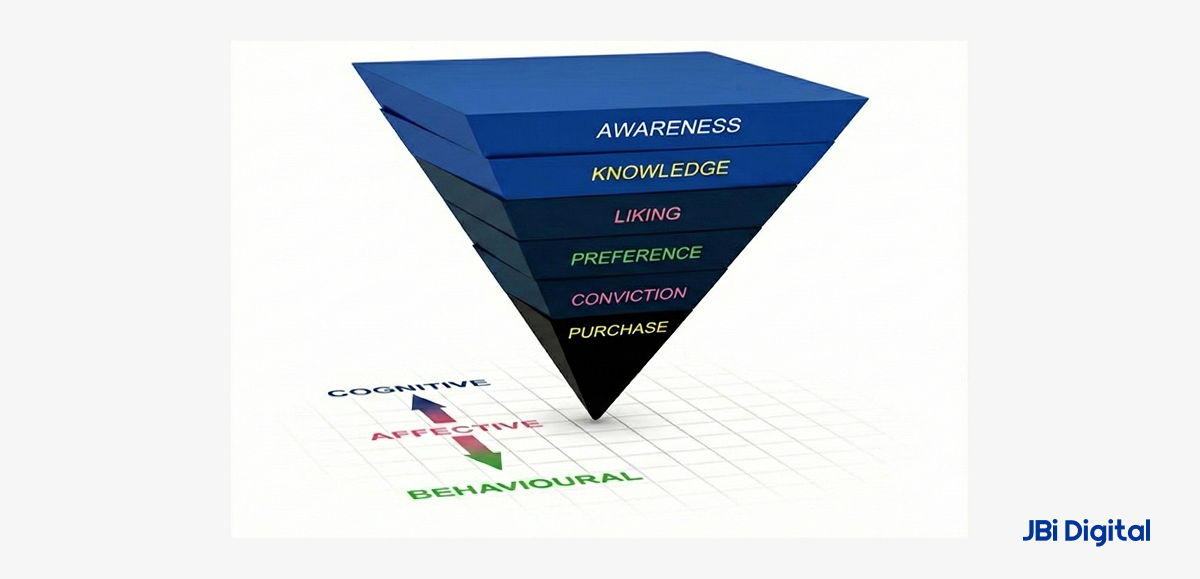
- The Action: We audit your high-traffic pages to ensure they answer customer questions immediately. Does your page capture the user’s intent in the first 50 words? This “conclusion-first” format is the key to winning Google’s Featured Snippets and Voice Search results.
- The JBi Insight: We utilise advanced linguistic analysis (NLP) to ensure your content matches the reading level and logical structure that AI models prefer. We make your content the easiest for the AI to “read” and recite, ensuring your brand is the chosen answer.
Phase 2: Translating Your Brand DNA for Machines
Great content is useless if the AI doesn’t understand who owns it. We need to explicitly translate your brand identity into a format machines can read (Structured Data/Schema).
- The Action: We implement a “Digital Identity” strategy using advanced Schema.
- Defining Your Offer: We code your services so Google explicitly understands what you sell, preventing confusion with competitors.
- Validating Your Authority: We digitally link your website to your verified profiles (LinkedIn, Crunchbase, Wikipedia) to prove your legitimacy to the algorithm.
- The Business Impact: This code acts as the “connective tissue” between your brand and your industry topics. It protects your brand safety by making it difficult for AI to “hallucinate” incorrect facts about your business or confuse you with a similar-sounding company.
Frequently Asked Questions: AEO, GEO, and the Future of Search
Q: How do AEO and GEO differ from the SEO we already do?
A: It is a shift from Traffic to Utility. Traditional SEO targets “clicks” (getting a user to your site). AEO and GEO target “citations” (getting your content read aloud or summarised by AI). You are no longer optimising for a position in a list; you are optimising to be the single, definitive answer selected by the engine.
Q: Why is it critical to act now rather than wait?
A: Because your competitors are effectively training the models. Generative engines select an “expert” and stick with them. If your competitor’s content is the one being cited today, those references become reinforced in future model training cycles. Early investment compounds; late adopters risk being permanently excluded from the AI’s “long-term memory.”
Q: Is AEO only for text content?
A: No. Search is becoming “Multi-Modal.” AI agents now synthesise information from videos, images, voice, and PDFs. Optimisation requires ensuring your video scripts, product manuals, and visual assets are structured so machines can “read” and cite them just as easily as text.
Q: How does Personalisation affect these results?
A: AI Overviews are becoming hyper-personalised, incorporating user location, past behaviour, and preferences. This creates a “Brand Moat.” If you establish your brand as the “default answer” for a specific service (e.g., “Council Tax”) in a user’s personalised graph, you become the automatic suggestion for all their future queries, locking out competitors.
Q: Why is “Content Freshness” suddenly a critical ranking factor?
A: Traditional SEO often tolerated older, “evergreen” content. Generative AI does not. Models like ChatGPT heavily weight real-time accuracy to avoid hallucinations. If your content is outdated, it is often discarded during the synthesis process. To be cited, your data must be current.
Q: Why is this considered a Legal and Governance issue?
A: It is actually a threefold risk: legal, financial, and reputational. Incorrect AI answers can lead to compliance breaches, but they also erode consumer trust. If an AI “hallucinates” a refund policy or product claim based on a third-party forum, the fallout doesn’t just increase customer service costs; it damages your standing in the market and directly impacts sales. AEO mitigates this by strictly defining your official data as the single source of truth for the models.
Q: Why optimise for “Zero-Click” if I don’t get the traffic?
A: Because generative engines operate on a “Winner Takes All” basis. They don’t list ten options; they often choose one. If you are the cited source, you own the category leadership and brand trust. If you are not, you are invisible.
The JBi Verdict
Navigating this shift requires balance. We are not suggesting you abandon the SEO strategies that have served you well; rather, we are advocating for their evolution. Relying exclusively on traditional keyword tactics is now a calculated risk in a market shifting toward generative answers.
By integrating AEO and GEO into your digital roadmap, you do more than just “rank.” You establish your organisation as the definitive authority in your industry. You ensure that whether a user searches with a keyboard, a voice command, or an AI prompt, your brand provides the answer they trust.

